Showing posts with label Pets. Show all posts

Friday, December 09, 2011

Fat Cats & Lucky Dogs

I have just finished reading Fat Cats & Lucky Dogs: How to leave (some of) your estate to your pet by Barry Seltzer and Gerry Beyer, and published by Prism Publishing Inc., 2010.

Fat Cats & Lucky Dogs offers practical advice on planning for your companion animals in case you die before them or you become incapacitated and are no longer able to care for your pets. The authors identify five situations in which your pets can run into problems. They are:

1. When you are incapacitated.
2. Immediately after you die and your pets are home alone.
3. Between the time you die and the time your will is read.
4. Between death and the admission of your will to probate.
5. The ongoing period after your death.
You can plan for each of these five situations, and the authors offer suggestions for each of them, ranging from informal arrangements such as asking a friend to take care of your pet and then leaving your pet to that person in your will, to formal trusts with funds provided on an ongoing basis to your caregiver, with an independent trustee and protector to monitor the administration of the trust.

This book is written for pet owners, and is easy to read. As the title implies, the book has a nice playful style, with pet trivia or “factoids,” and humourous quotations. One of my favourite quotations has to come from one of my favourite humour writers, Dave Barry:

You can say any fool thing to a dog, and the dog will give you this look that says, ‘My God, you’re RIGHT! I NEVER would’ve thought of that!’
Fat Cats & Lucky Dogs sets out the legal framework for estate planning for pets, in Canada and the United States, and to a lesser extent in Australia, New Zealand and the United Kingdom. As the authors note, the law does vary from place to place. I found it quite interesting to learn that many States in the United States have legislation recognizing and facilitating the creation of trusts for animals.

There is a variety of resources in the appendices, such as a summary of state laws, a list of prohibited versus acceptable animals as pets, and contact information for animal retirement homes, temporary pet care providers and sanctuaries.

Fat Cats & Lucky Dogs was helpful to me as an estate-planning lawyer in raising my awareness of some of the issues those of my clients with pets should consider in their estate and incapacity planning.

Barry Seltzer is a lawyer practicing in Richmond Hill, Ontario. Gerry Beyer is Governor Preston E. Smith Regents Professor of Law, at Texas Tech University School of Law. Professor Beyer is also the author of Wills, Trusts & Estates Prof Blog.

Monday, September 11, 2006

Professor Beyer on Estate Planning for Pets

Professor Gerry W. Beyer has posted links on his Wills Trusts and Estates Prof Blog to some of his articles on estate planning for pets. To quote his post, with links:

For the non-attorney audience, I have posted the "Top 20" most frequently asked questions about pet trusts as well as an article entitled Prepare for Your Companion Pet's Future which was prepared for Phoenix Landing and includes special tips for parrot owners.

For attorneys, I have posted an article entitled Estate Planning for Non-Human Family Members.

You may be interested to note that at least 38 jurisdictions now have statutes specifically addressing pet trusts.

In his articles Professor Beyer offers thoughtful, practical analysis of the issues involved in planning for a pet's care.

Although Professor Beyer is writing about U.S. law, which differs from B.C. law, many of the same considerations apply in British Columbia. We do not have legislation specifically dealing with pet trusts, but in British Columbia you can set up a trust to fund the care of your pet using what Professor Beyer refers to as the traditional trust method.

Saturday, February 18, 2006

They Shoot Horses, Don't They?

A couple of days ago a wrote a post here about estate planning for your pets. Today I am going to write about an estate plan--of sorts--for horses. But this is not an estate plan that I would ever recommend.

Mr. Clive Wishart of Tabusintac, New Brunswick died on May 31, 1991. He had made a Will fourteen months earlier, which provided:

I DIRECT AND DECLARE that my Executors have my horses shot by the Royal Canadian Mounted Police and then buried.

The Royal Canadian Mounted Police were not keen on the idea. They would not shoot Mr. Wishart’s four horses, Barney, Bill, Jack and King, unless the court said they had to.

Mr. Wishart’s executors, whose responsibility it was to carry out the will, were not overly enthusiastic about this provision either. They asked the court what to do.

The judge who heard the case of Re Wishart Estate (1992), 46 E.T.R. 311, Justice Riordon of the New Brunswick Court of Queen’s Bench, did not relish the idea of anyone shooting the horses either. Justice Riordon, quoting from an excerpt of the 1970 edition of Encyclopaedia Britannica, said “John Trotwood Moore, in a tribute to the horse wrote: ‘Wherever man has left his footprint in the long ascent from barbarism to civilization we will find the hoofprint of the horse beside it.’”

Whatever the Justice Riordon’s sentiments might be, the court had to decide the case according to the law. The horses were Clive Wishart’s property. One may legally have one’s animals killed provided it is done humanely. Mr. Wishart had the right to dispose of his horses by his will, and it could be argued that this right included the right to have them put down. If this were correct, it would be the duty of the executors to have Mr. Wishart’s wishes carried out.

According to Justice Riordon, “The decision the court has a responsibility to make cannot be based on sentiment or public opinion but must be based on legal principles in accordance with the law of the land.”

In deciding this case the Justice Riordon looked beyond the words of the will at Mr. Wishart’s underlying motivations and intentions. Clive Wishart was not a cruel man. On the contrary, the evidence was that he loved his horses. One witness said that his “horses were treated royally.” He was concerned about the welfare of his horses after his death, and he feared that they might be abused.

Riordon J. held that Mr. Wishart’s true intentions that the horses not be abused could be upheld without having the horses killed. The New Brunswick Society for the Prevention of Cruelty found people who were interested in taking care of the horses, and the Society was willing to provide supervision to make sure that the horses would be properly looked after. Justice Riordon ordered that the horses’ lives be spared.

But what if Clive Wishart had not been concerned about the horses’ welfare? What if he had put this provision in his will that his horses were to be shot capriciously? Would the court have then held that the executors had to carry out this provision of the will?

Justice Riordon held that this clause was against public policy, and the court would not enforce it. There are restrictions on what a person can have done by will, if carrying out the terms of the will is harmful to the community. According to the Justice Riordon,

In my opinion, the destruction of four healthy animals for no useful purpose should not be upheld and should not be approved. To destroy the horses would benefit no one and would be a waste of resources and estate assets even if carried out humanely. It is my conclusion that to destroy Barney, Bill, Jack and King as directed in the will at this time and in present circumstances would be contrary to public policy.

Wednesday, February 15, 2006

Estate Planning for Pets

No. I don't mean that your pets need any estate planning advice. I was thinking about how you might deal with pets in your will.

The first question you may address is to whom you wish to leave your pets. The law treats animals as property, and you can leave your pets to a beneficiary under your will. It makes sense to talk to your intended beneficiary before making your will, to make sure that he or she is willing to care for your pets. You may also designate an alternate beneficiary, if at the time of your death your first choice is unable or unwilling to care for your pets.

We suggest that you describe any pets generically as “any pets I may own at my death,” “any animals I may own at my death” or “any cats I may own at my death,” as appropriate instead of referring to a specific pet. By using a generic description, you will allow for the possibility that your pet may die before you, and you may get another pet.

Although you obviously cannot leave money directly to your pets, you can provide for a trust fund to be held by your executor or by some other person you name as a trustee of the trust fund to provide for your pets’ care. Your trustee of the trust fund would then invest the funds, and you could give the trustee power to decide how much of the capital and income to spend on your pets to meet any costs. If you have a trust fund set up in your will for your pets, you need to say in your will what will happen to any balance in the trust fund on the death of your pets.

If you are leaving a substantial financial gift to the beneficiary of your pets, a trust fund for pets might not be necessary. However, in some cases, if the cost of caring for your pets is significant, or if you are concerned that the beneficiary of your pets might have difficulty affording these costs, you may consider a formal trust fund.


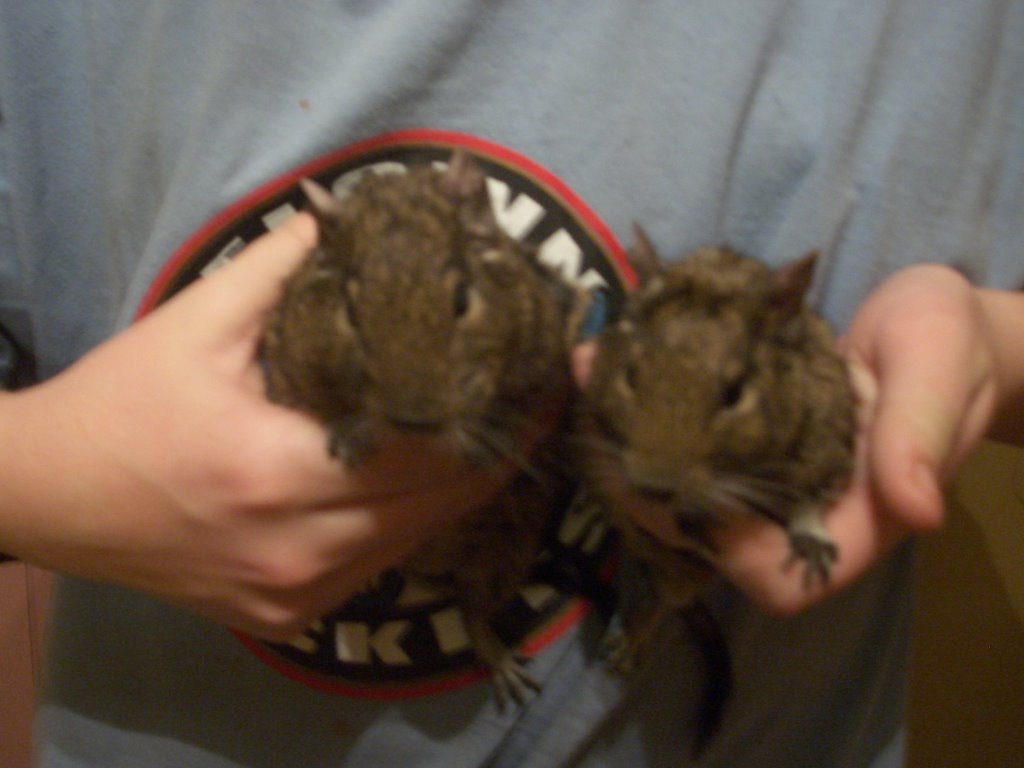
Trust funds for degus? Michele Rule took this photograph of our pet degus, Lewis and Clark, being held by our son Justin.