Saturday, November 27, 2021
Jana Keeley Joins Sabey Rule
Sunday, April 11, 2021
Shahdin Farsai Joins Sabey Rule LLP
I am pleased to post that Shahdin Farsai has joined our firm as an associate lawyer. She was a judicial clerk to six judges at the Supreme Court of British Columbia in 2015-2016. She articled and then was as an associate lawyer in Vancouver at a large national firm, where she practiced in civil litigation. She plans to focus her practice with us primarily in the areas of estate planning, estate administration and estate litigation.
Most recently, she spent a year in Finland.
She speaks Farsi fluently, and can converse in French and Finnish.
Sunday, October 16, 2016
British Columbia Law Institute
· promote the clarification and simplification of the law and its adaptation to modern social needs,
· promote improvement of the administration of justice and respect for the rule of law, and
· promote and carry out scholarly legal research.
Monday, May 30, 2016
Sabey Rule LLP Announces Association with Ken M. Kramer Q.C. and KMK Law Corporation.
Ken will assist Sabey Rule LLP in serving our clients, particularly in the Greater Vancouver Area. We will be working together on significant estate disputes. He will also be a valuable resource to our lawyers in Kelowna.
Monday, October 13, 2014
John Poyser’s Capacity and Undue Influence
Sunday, November 02, 2008
"Caregiving and the Case for Testatmentary Freedom"
I read Professor Tate’s article from the perspective of a British Columbia lawyer who thinks independent adult children should continue to be able to apply to court to vary a parent’s will.
Professor Tate outlines three different approaches to who inherits a person’s wealth.
At one end, there are some places where the laws provide who gets what on a person’s death. This is forced heir-ship. The deceased either has no ability to choose his heirs, or has only a very limited ability.
At the other end, there are places where each person has complete freedom to leave his wealth to whomever he chooses in his will. This is the approach taken in many American States.
Professor Tate refers to a third approach as a family maintenance approach. The testator may choose whom to leave his property in his will, but certain family members may apply to court to vary the will.
In British Columbia, we take the third approach. Although we have the freedom to decide how to distribute our property at death, a spouse or child can apply to court to vary the will. If the court finds adequate provision has not been made for the spouse or child, the court may make an award the court considers adequate, just and equitable in the circumstances.
Professor Tate argues that allowing complete testamentary freedom encourages children to provide care to their elder parents. Parents can reward or encourage a child to provide care by giving the care-giving child a larger inheritance. The parent (rather than the state or a court) is in the best position to decide on how much to leave a care-giving child. Restrictions on testamentary freedom reduce the incentives to provide care.
In the context of the debate in British Columbia about whether to abolish the write of independent adult children to make a claim under the Wills Variation Act, Professor Tate’s thesis lends some support to those who think independent adult children should not be able to apply. (I am not aware of any serious debate among the wills and estate bar about abolishing the provisions of the Wills Variation Act altogether). At least some of the claims brought by independent adult children are claims against siblings who were their parents’ caregivers. By allowing wills to be varied in favour of the non-care-giving children, B.C. legislation weakens the ability of parents to reward or encourage care-giving.
But I think Professor Tate’s argument is a much stronger argument against a forced heir-ship approach than a family maintenance approach. In a forced heir-ship parents have much more limited ability to reward a care-giving child.
In British Columbia, a parent can reward a care-giving child. It is only if a spouse or another child chooses to apply to vary the will, that the will may be changed by the court. Most wills are never disputed. If there is a claim, the court may take into account the parent’s reasons, and any care provided by the care-giving child when deciding whether to vary a will.
If the Wills Variation Act weakens any incentives to children to provide care (and I think any such effect will be modest), this should be balanced against other important policies. For example, the Supreme Court of British Columbia has applied the Wills Variation Act to redress discrimination against daughters based on their sex in one case, and against a child based on his sexual preference in another.
As an aside, I particularly enjoyed reading Professor Tate’s historical discussion in Part III of the evolution of testamentary freedom from our shared English common law roots (which did not favour testamentary freedom).
Saturday, October 18, 2008
The Family War
The Family War is written by Jordan M. Atin, Barry Fish and Les Kotzer. Mr. Atin is a senior associate with the law firm of Hull & Hull LLP in Toronto (the firm that authors the Toronto Estate Law Blog). Mr. Fish is senior partner at Fish and Associates, in Thornhill, Ontario. Mr. Kotzer is an associate lawyer at Fish and Associates. This book was published Continental Atlantic Publications Inc. in 2006. You can order it here.
I find the subtitle “Winning the Inheritance Battle” ironic, because the authors spell out the emotional toll estate disputes take on the participants, including the winners:
Rarely can the winner of a Family War declare that his or her victory was absolute. You must look long and hard to find someone who takes a brother or sister all the way through the court system, completely conquers them, and simply doesn’t care about the emotional fallout that such a victory leaves in its wake. There is almost never an absolute winner. The fact that family members are fighting means that the War will have a cost. Are you a winner if the victory means destroyed relationships with other family members or feelings of shame or guilt if you feel that you have let your parents down? These costs will continue long after the litigation ends and the lawyers are paid.
I agree.
The Family War sets out some examples of estate disputes, discusses the types of disputes that arise in estate litigation, offers advice for preventing disputes, and guidance for resolving disputes. I think the discussion under “After Death Strategies – What Children Can Do” in Chapter 6 “Strategies to Prevent Estate Litigation,” may be particularly helpful to those involved in estate disputes. The overriding message: be reasonable.
It is not a textbook of substantive law for lawyers. The authors discuss the law in a general way, and point out that the law will vary from province to province in Canada. It is a useful starting point for non-lawyers trying to understand the legal issues in estate disputes.
This book is written in plain language, accessible to all.
The Family War will not replace the services of a lawyer who practices this area of law (nor will any other book), but it is a great supplement to using the services of a lawyer. If you are involved in an estate dispute, reading this book may help reduce your legal costs by giving you a good perspective, and sound practical advice for working with your lawyer.
Thursday, January 24, 2008
Joint Sitting of B.C. Courts to Honour the Late Allan McEachern
You may read some information on Mr. McEachern on the The Law Society of British Columbia website. I am going to quote a passage from the President of the Law Society, John Hunter QC's statement, which, as a legal blogger, I find inspiring:
'One of Mr. McEachern's greatest achievements was to open up the courts not just to the people of BC, but to the entire world via the internet,' Mr. Hunter said. 'In 1996, he pushed the courts to develop a website and to post judgments so the public could have instant, cost-effective access to legal decisions. Then he went a step further by hosting his own website and inviting the public to email their questions about the legal system. He was certainly the first chief justice in Canada -- if not the first judge in the world -- to step out of judicial cloisters and make himself accessible to everyone through the internet.'
I can think of at least a couple of notable estate litigation judgments written by Justice McEachern. One of them is his concurring judgment as Chief Justice of the Court of Appeal in Clarkson v. McCrossen, (1995), 3 B.C.L.R. (3d) 80, which deals with an unjust enrichment claim by a step child. He also wrote a frequently cited judgment as Chief Justice of the Supreme Court of British Columbia in an undue influence, and wills variation case called Dalziel v. Bradford (1985), 62 B.C.L.R. 215
Thursday, December 27, 2007
Practitioner’s Guide to Trusts, Estates and Trust Returns
Larry H. Frostiak and John E.S. Poyser have remarkable skills in explaining tax law in an easy-to-read manner. They have done so in the 2006-2007 edition of their book, Practitioner’s Guide to Trusts, Estates and Trust Returns, Toronto: (Thompson Canada Limited, 2006).
My only criticism of the book is that I don’t think the title fully captures the breadth of the topics. This book is divided into four parts: Estate and Trust Planning, Taxation of Trusts and Beneficiaries, Filing Requirements and Administration by CRA [Canada Revenue Agency], and Preparing the T3 Trust Information and Income Tax Return.
The first two parts were of greatest interest to me as an estate planning lawyer. In Chapter 2, the authors review the tax features of personal estate planning techniques, including testamentary trusts, inter vivos trusts (including alter ego and joint partner trusts), spousal trusts, insurance trusts, charitable remainder trusts. Mr. Frostiak and Mr. Poyser write about potential pitfalls, matters of critical importance to practitioners.
Chapters 3 through 5 contain a discussion of taxation rules for trusts, beneficiaries of trusts, and those who contribute to trusts. In Chapter 6, the writers talk about the tax rules when property is transferred out of a trust.
I find these to be complex topics, but they are not written that way. The text sets out the rules in plain language, and then the footnotes cross-references the relevant Income Tax Act sections. This avoids the mind numbing experience of staring at the impenetrable prose of the Income Tax Act in the middle of the page. The authors also cite relevant Interpretation Bulletins, and other documents setting out Canada Revenue Agency’s views.
In Chapter 7, Mr. Poyser, and Mr. Frostiak discuss the use of trusts. They talk about techniques to minimize taxes, such as estate freezes, and the use of multiple testamentary trusts.
Chapters 8 and 9 cover the basics of filing requirements and Canada Revenue Agency’s administration. The authors answer questions such as what needs to be filed, and when? They talk about practical estate and trust administration issues, such as how to close the estates for income tax purposes to get the clearance certificate required before the executor or administrator can make a final distribution.
Chapters 10 through 16 set out the nuts-and-bolts of filing in the tax returns for a trust. I found this had useful information for me. But I expect it will be of greatest assistance to accountants, who are involved in preparing the returns.
Practitioner’s Guide to Trusts, Estates and Trust Returns offers estate lawyers, accountants and financial planners an excellent overview of the important tax law points that affect an estate practice. This book is also is a handy reference.
I look forward to reading the 2007-2008 edition, which includes material on non-resident trusts, and is just coming out.
Saturday, April 14, 2007
Waters' Law of Trusts in Canada
Professors Waters, Gillen and Smith provide a comprehensive treatment of Canadian trust law. This book is remarkable both for its breadth and depth. Although focused on Canadian law, the book cites the older English authorities, as well as other Commonwealth and American cases. They analyze trust law in its historical context, but they are forward looking, suggesting areas in need of reform.
This book is divided into thirty chapters. It covers how express trusts are created, and how they may arise by operation of law. There is an excellent chapter on charitable trusts. The book deals with such mundane, practical issues as appointing successor trustees, and trustees’ duties to account to beneficiaries. It also deals with fascinating, but more esoteric, issues such as whether The Hague Convention on the Law Applicable to Trusts and on their Recognition allows a resident of a jurisdictions that has implemented the convention to avoid domestic restrictions on trust law by choosing the laws of foreign jurisdictions even if the trust, assets and beneficiaries do not have any other connection to the foreign jurisdictions.
Waters’ Law of Trusts in Canada also has an interesting discussion on the evolution of trustee investment powers in Canada. The authors look at the historical relationship between the types of investments trustees were permitted to make, and the rules requiring trustees to keep an even hand between income and capital beneficiaries. Certain types of investments were once seen as both safe, and as providing a fair return to income beneficiaries, while preserving capital. With changes in the economy, and modern portfolio investment theory, trust law in most Canadian provinces has moved to a more flexible prudent investor standard. But, the types of investments a prudent investor might invest in to maximize the total return to the trust may change the balance between income and capital beneficiaries. The authors suggest investment decisions could be divorced from even hand considerations by creating “unitrusts” or “percentage trusts.” In other words, instead of income, some beneficiaries get a percentage of the trust funds each year.
How influential is Waters’ Law of Trusts in Canada? I searched “Waters” and “law of trusts” on the Canlii website, and got 435 cases. The Canlii website contains relatively recent cases only (it goes back to about 1990 for B.C. cases). The Supreme Court of Canada cited the 3rd edition in its decision in Buschau v. Rogers Communications Inc., 2006 SCC 28, [2006] 1 S.C.R. 973. I found about 15 Supreme Court of Canada cases in which the court cited the 2nd edition, which came out in 1984. I cannot think of any Supreme Court of Canada cases dealing with trust law since 1984 that have not cited either the 2nd or 3rd edition.
Waters’ Law of Trusts in Canada is my starting point for research into trust law issues.
Friday, February 09, 2007
Mr. Attorney- Don't Change The Wills Variation Act - By Trevor Todd
[My friend Trevor Todd is a Vancouver lawyer who practices estate litigation exclusively. He is very concerned about proposals that if passed would eliminate the right of many adult children to make claims under the Wills Variation Act, RSBC 1996, c. 490. Trevor has kindly authorized me to post this article as a guest post. He has several other excellent articles on his website: Disinherited.com.]
In the summer of 2006 the British Columbia Law Institute delivered to the Attorney General a sweeping report entitled Wills, Estates and Succession: A Modern Legal Framework. Many of that report's recommendations involve well-considered and welcome changes.
There are two recommendations in that report, however, which appear to be ill-considered and arguably contrary to public policy. Specifically the problematic recommendations propose changing the Wills Variation Act.
The Wills Variation Act permits a spouse or child to contest a will where it does not make adequate provision for them. The class of claimants eligible to bring such a claim includes any spouse, common-law spouse or same-sex spouse and includes both the natural and adopted children of the deceased.
The troublesome changes proposed in the report would:
a) eliminate adult children as claimants unless they are unable to be self supporting; and
b) discourage lump sum payments under the Act in favour of periodic maintenance
The supposed "rationale" for the proposed changes is to make the law of British Columbia consistent with the law in other Provinces. In fact, we say that British Columbia, is actually ahead of the other Provinces. Our legislation permits B.C. courts to bring more fairness into the law of wills and succession by introducing the principles of equity.
These proposed changes would reverse almost 90 years of jurisprudence enforcing the claims of adult children, who have not been adequately provided for in a parent's will. We believe it is contrary to good public policy to abolish these long standing rights. Indeed the only apparent rationale is to provide certainty to both testators and to their solicitors who do not like to see their well-crafted wills rewritten.
In this paper, we intend to briefly sketch the background to the legislation and illustrate, with real life examples, the clear need for such legislation.
Today's Society
The potential for inheritance conflicts has been growing, especially with the increasing number of "blended family" situations and second or even third families. In such cases there may be differing perceptions of any obligation to provide an inheritance for younger children, as opposed to older more established children.
The question of a child's "entitlement" to share in a parent's estate often provokes a lively discussion. Thus it is common, in our experience, for people to criticize the Wills Variation Act because it permits mere "malcontents" to contest a will. It is said these ingrates should instead be grateful for whatever their parents have given them.
Unfortunately such critics simply do not appreciate that many successful claims involve disempowered individuals who have been raised in dysfunctional families. Too often, the last act of abuse by an abusive parent is to disinherit their child. For example, we have had a couple of cases involving childhood incest victims who have been disinherited as adult women, yet they will carry the scars of this devastating abuse all their lives. This is just one type of claim which would be eliminated if the legislation is passed.
Let us begin by reviewing three recent successful claims which would be eliminated by the proposed changes. Perhaps these examples will help to illustrate the dangers of "tinkering" with this legislation-particularly in an increasingly diverse and multi-cultural society.
1) The cultural bias for males over females-preferring sons over daughters in wills.
Many cultures, including for example, South Asians and Chinese, commonly favour sons over daughters both in life and in death. The decision of Prakash and Singh v. Singh et al 2006 BCSC 1545 involves such a case. Most of the mother's estate went to her sons. They were left bequests of $260,000 each compared to the $ 10,000 left to each of three daughters.
Mr. Justice Rice, increased the daughters bequests to an almost equal share with the sons. In doing so he eloquently stated:
" In modern Canada, where the rights of the individual and equality are protected by law, the norm is for daughters to have the same expectations as sons when it comes to sharing in their parents estates. That the daughters in this case would have this expectation should not come as a surprise. They have lived most of their lives, and their children have lived all of their lives, in Canada.
A tradition of leaving the lion's share to the sons may work agreeably in other societies with other value systems that legitimize it, but in our society, such a disparity has no legitimate context. It is bound to be unfair, and it runs afoul of the statute of this Province."
2) Disinheriting Gays and Lesbians
Peden, Smith et al 2006 BCSC 1713 involved a deceased who left three sons, two heterosexual sons and one gay son. The Deceased's will provided that the two heterosexual sons would receive an outright inheritance whereas the gay son would receive only the income of a share to be held in trust during his lifetime. The capital of his share would be left to his two brothers after his death. The drafting lawyer gave evidence that the deceased had been greatly upset that his son was gay and actually had wanted to completely disinherit him. The court concluded that it was the son's gay lifestyle which had thus caused the deceased to dispose of his estate as he did.
The court varied the will and converted the life estate to be an outright direct gift to the gay son. In so doing, the court observed "homosexuality is not a factor in today's society justifying a judicious parent disinheriting or limiting benefits to his child."
3) A Child Abandoned to a Life of Abuse and Deprivation by Her Mother
Austin v. Janzen Estate involved a plaintiff who was born illegitimate. Her mother, rather than putting the girl up for adoption, farmed her out to an abusive home. Over the years, the mother paid $ 20 per month to have her daughter raised by this abusive family. She visited occasionally until she had a new boyfriend. She continued to repeatedly reject this daughter. For example, their last contact was when the 14 year old daughter wrote to ask for money for badly needed dental treatment. The mother wrote back that she could not afford the money because she needed it to paint the nursery for the new baby she and her husband were about to adopt.
This mother effectively abandoned the plaintiff yet went on to be a loving and supportive mother to two adopted daughters. Not surprisingly these adopted daughters were well educated and enjoyed happy successful marriages and lives. On the other hand, the plaintiff left school when she was young and struggled through abusive marriages and many other traumatic events.
At age 60 the plaintiff learned her mother had died leaving her very sizable estate to her two adopted daughters. To the plaintiff she left $100.
The Court varied the will to provide for an equal one third to each daughter.
Background - Testamentary Freedom at Common Law
Any discussion of the Wills Variation Act requires an understanding of the English common law underlying the legislation.
English common law provided that when a person died, that person could leave his or her property to whomsoever he or she wished.
This ability to dispose of one's estate is known as "testamentary autonomy " or "testamentary freedom". It is legal doctrine which was developed by the English courts during a time (1700-1900) when little property was actually disposed of by will.
During that time, few people actually had assets to leave in a will. Most wealth was made up of real property which was generally considered to be family property. Because it did not belong to the individual, it was not part of the estate to be disposed of by will upon death.
When the children of wealthy families married, their families often made marriage settlements which included conditions with respect to the ownership of the property and its passage upon death. Thus, property governed by a settlement was not part of an individual's estate.
It was in this context that the English courts decided that a testator was free to decide the beneficiaries to inherit under his or her will.
Thus, the English law of succession left it to the discretion of testators to dispose of their estates as they saw fit. Even today at common law testators are not legally obliged to make provision for their spouse or children. There is no binding obligation to leave a set amount to their spouse or their children.
This English common law was inherited by all of the former English colonies, including Canada. It is noteworthy that this common law approach is in stark contrast to most of the rest of the world. The law of most civil law countries (all of Europe but for England, South America, Africa, Japan) requires that the majority of a person's estate pass on death to their spouse and children.
In civil law countries which include most of the non-English speaking world, a fixed portion of a deceased's estate (often 50% to 75%) passes automatically to the surviving spouse and children. The testator can only dispose freely of a smaller portion of his or her estate. The credo seems to be "you had them, you pay for them".
In our common law world, this historic common law doctrine of testamentary freedom has been modified by statutes such as the Wills Variation Act which permit the spouse or children to make a claim against the estate in appropriate circumstances. Unless there is a successful statutory claim brought under the Wills Variation Act, however, the principle of testamentary freedom still prevails at common law.
We contend that our Canadian society should not be slaves to the historic concept of testamentary autonomy. The common law is always focused backwards and the usefulness of this out-dated concept is extremely questionable. Quite simply, the Wills Variation Act provides for equity to be done, where appropriate. Eliminating the claims by adult children would prevent the courts from doing equity in appropriate circumstances. It is for that reason we strongly suggest that eliminating appropriate Wills Variation Act claims would be a move backwards rather than forwards.
It is only assets that actually form part of the deceased's estate which are subject to Wills Variation Act claims. Testators, who are truly determined to disinherit their children, may still use trusts and inter vivos transfers to circumvent the Act. Indeed the rich have historically utilized trusts to circumvent the Act and other statutory law. Many will continue to do so. It is not illegal to arrange one's affairs to avoid the application of the Act altogether.
Claims under the Wills Variation Act by Adult Children
In our practice, claims frequently involve the children of abusive and alcoholic parents, generally fathers. We hear a recurring theme - a father coming home drunk after work, beating his wife and children, and generally terrorizing the family on an ongoing basis. Many of these children leave home at very early ages, and quite understandably bear a strong resentment against the abusive parent. Some become substance abusers themselves. At best, they remain emotionally damaged individuals.
Naturally such abusive parents generally have little insight as to the lifelong effects of their mistreatment. Thus the abuser, when preparing his or her will, will typically disinherit the children on the basis of estrangement. The handling lawyer or notary often just accepts this statement as the truth of the matter and makes little enquiry into the history of the estrangement.
Most of us had the remarkable fortune to be raised in happy, healthy families. But just ask any experienced teacher, minister, police officer or doctor and they will attest to the great number of dysfunctional families. A visit to the Canadian Department of Justice Family Violence fact sheet indicates much more family violence than we would wish to believe. There is a large body of information available that attests to the unfortunate frequency of such dysfunctional families.
In our practice many of the estrangement cases involve a history of physical, emotional and/or sexual abuse by the parent or step-parent toward the child. Where the estrangement can be properly explained and put into perspective, then the adult child may well have a meritorious claim under the Wills Variation Act.
Two Real Life Examples from our practice:
Example 1 involves a claim made by the three adult independent children relating to the death of their father, Mr. M, a victim of murder.
Mr. M had been married for almost 50 years when his first wife died. He had a good relationship with his three adult children and his grandchildren. Living alone, however, he became very lonely and depressed and thus engaged Ms. R through an "escort service".
Shortly after they met, Ms. R moved into the deceased's residence. Mr. M was 71 and Ms. R was 41. Ms. R changed the residential phone number to her own unlisted number and soon completely isolated Mr. M from his children. Within two months they "married" (unbeknownst to Mr. M, his "bride" was still legally married to another man). On their tropical "honeymoon" he was treated at a medical clinic for a lacerated scrotum-it appeared that he had been kicked. Shortly after the marriage Mr. M prepared a new will leaving his entire estate to R, and alternatively to her daughter, thus completely disinheriting his own three children.
Once back in Canada, the " bride" began to run her escort service out of their now joint home, publishing ads that she "specialized in seniors". This so-called marriage ended abruptly a few weeks later when Ms. R beat Mr. M to death. In fact, she beat him so severely she broke every rib in his body. She was subsequently convicted of his murder and thus became disentitled to share in his estate. As a wrongdoer, she was prevented by law from benefiting from her own crime.
In these circumstances, however, Ms. R's daughter arguably continued to have a valid claim as the alternate beneficiary under the will. This daughter had never met the deceased. At common law, however, testamentary freedom prevails and this daughter had done no wrong. Ms. R's daughter was very arguably entitled to receive the entire estate as the named beneficiary under the will.
Fortunately however, an application under the Wills Variation Act led to the court rewriting the will to leave the estate instead to Mr. M's three adult children.
Example 2 involves a 40 year old woman known as S. She had been adopted at age 7 by the Deceased and her husband, it seems more as a servant than as a child. She was made to work long hours at her "mother's" puppy farm business. Each morning S rose at 4.30 am to feed and care for 100 animals before catching the school bus into town for school. The Deceased would routinely beat her for any perceived misbehaviour or insubordination. In extreme situations, she was denied food. The Deceased wore the pants in the family and her husband, rather a more kindly man, did not intervene on S's behalf. Presumably, he too was victimized by his wife.
S skipped school for the first time at age 16 (one Friday afternoon, in order to help her friend prepare for the friend's mother's release from hospital). S learned from her father that the deceased intended to beat her so she stayed away until Sunday, hoping her mother would cool down. When she phoned home her mother told she had already burned all of her possessions and would be putting her dog down. The mother said "You came into the house with nothing and you will leave with nothing".
This Deceased not only disowned S, she obliged her husband and other family members to disown S as well. (Fortunately one kindly aunt defied this order, however, she too paid the price for disobedience.)
S was homeless and taken in by friends. With few options, she became pregnant and married a severely abusive man who continued to abuse her and the children for years. He beat her and starved her and the children while she was pregnant-gambling all their money away. Their third child, a son, was born severely disabled child. S finally summoned the courage to leave him raising her children on her own for 24 years. She continues to care for this adult son who cannot speak and is incontinent. He weighs only 40-45 pounds and is catastrophically injured in every sense of the word.
Nevertheless S managed to get a university education by attending classes while her son was at eligible government care as a child. Once he became an adult however, this eligibility ended and she continued to care for him full-time rather than putting him into an institution.
S was a very kind person who repaid her aunt's kindness many times over. She also attempted to contact her adopted mother on several occasions, but was rebuffed at each turn.
The Deceased died leaving an estate of approximately $250,000. Her will provided S with a bequest of $5,000 on the basis that they had been estranged for 25 years.
We commenced a Wills Variation claim on her behalf however once the proper facts were brought to the attention of the executor and beneficiaries of the estate, the case was settled with S receiving one-half of the net estate.
Summary of Basic Principles --The Clucas Decision
Madam Justice Satanove, in Clucas v. Clucas Estate 29 E.T.R.(2d) 222, did an excellent summary of the basic principles of the Wills Variation Act.
Let us paraphrase those principles briefly.
The main object of the Act is to provide adequate, just and equitable provision for the testators’ surviving spouse and children.
The Act also protects the interest in testamentary freedom which is not to be interfered with lightly. In the absence of other evidence, a testator is presumed to know best how to meet his legitimate obligations and concerns.
The Act provides an objective standard by which to measure whether a testator has provided "adequate and proper maintenance and support" for his surviving spouse and children. Thus the court should examine the will keeping in mind society's reasonable expectations of what a judicious parent would do in the circumstances.
In making a determination, the court must consider any legal obligations of the testator to the spouse and children, followed by the moral obligations to them.
Independent adult children have a more tenuous moral claim than any spouse or dependent adult children. If the size of the estate permits, however, parents should generally make some provision for adult independent children (unless there are circumstances which rule out such an obligation)
A testator may have a moral duty to adult children in a number of different circumstances including disability, legitimate expectation of inheritance, probable future difficulties of the child; the size of the estate and other legitimate claims.
This moral obligation by a testator may be negated by "valid and rational" reasons which justify disinheriting the child. In such a case, these reasons must be based on true facts and must be logically connected to the disinheritance
Although a needs/maintenance test is no longer the sole factor governing such claims, a consideration of needs is still relevant.
Conclusion
The purpose of this paper has been to demonstrate there are many circumstances in which the Wills Variation Act allows equity to be done for adult children. That ought not to change.
In effect the British Columbia Court of Appeal has specifically recognized dysfunctional families in their decision Gray v. Nantel 2002 BCCA 94. In permitting the claim of an estranged child, Mr. Justice Donald, spoke for the court:
"I cannot accept that a child so neglected for his first 18 years and then treated shabbily during a brief reconciliation can be said to forfeit the moral claim to a share in his father's estate by abandoning any further effort to establish a relationship. The fault in this sad story lies with the father and, in my opinion, the onus to seek further reconciliation was on his shoulders. The testator gave the appellant virtually nothing in an emotional or material way; the will was his last opportunity to do right by his son" (emphasis added)
For close to 90 years adult independent children have had the right for equity to be done, in appropriate circumstances, under the Wills Variation Act. The five actual cases discussed in this paper represent a small sampling of the legitimate claims brought under this Act by independent adult children.
If the current right to bring such actions is curtailed, it will particularly damaging to those already disempowered. It will eliminate the claims of the disempowered whether they be the daughters of Asian Canadian families, gays or victims of families abuse.
If you agree with the position in this article, then we encourage you to write to the Attorney General and to let your Provincial MLA know of your concern.
Copyright 2007, Trevor Todd.
Tuesday, January 23, 2007
Incentive Trusts
I have read about incentive trusts, but as far as I know they are not frequently used in British Columbia. In a nutshell, you can set up a trust, either during your lifetime, or in your will, the terms of which make any payments out of the trust to your children or other beneficiaries conditional upon them reaching specified goals. In this way, you can create financial incentives for your beneficiaries to behave in certain ways. For example, you may encourage the accumulation of wealth, educational achievement, charitable giving and even procreation.
Professor Tate gives examples of number of specific provisions, my favourite being "$10,000 on the first marriage of each descendant of mine, provided that the new spouse has never gone to law school."
Imposing conditions on beneficiaries before they can receive gifts in wills or trusts is not new. But I am under the impression that marketing conditional gifts as "incentive trusts" is a relatively recent phenomenon.
Professor Tate discusses what I think is the main problem with "incentive trusts": they may not be flexible enough to adequately deal with the various contingencies life presents. He provides some good examples, such as the following at pages 464 and 465,
With regard to educational conditions, an obvious possibility is that a beneficiary might be unfit to attend college and may need more support for this reason. This could happen, for example, if the beneficiary suffers from a learning disability. Such a beneficiary might not be accepted into a college or might have great difficulty achieving the minimum GPA fixed by the trust. If the settlor sets the bar too high, even beneficiaries without learning disabilities may be unable to meet the conditions [footnotes omitted].
In his paper, Professor Tate discusses the problem of inflexibility in the context of varying laws governing trusts within the United States of America. In some states, it is difficult for the beneficiaries or trustees to vary a trust with conditions that may not be very practical in the circumstances. The problem of inflexibility may be exacerbated in those states that allow trusts to continue in perpetuity.
The problem of inflexibility may not be as great of a problem in British Columbia as in some of the United States. As I have written in other posts, in British Columbia, in some circumstances the beneficiaries can all agree to terminate a trust, and the Trusts and Settlement Variation Act, RSBC 1996, c. 463, permits the Supreme Court of British Columbia to consent to a variation or termination of a trust on behalf of beneficiaries who do not have the legal capacity to consent. Except in the case of a charitable trusts, you cannot set up a trust in perpetuity.
Still, the kinds of conditions imposed by the creators of incentive trusts can create some formidable practical problems if the world does not unfold as they intended.
I was not a big fan of incentive trusts before I read Professor Tate's paper, and I am more skeptical about their utility since reading this article. I approach this as a practicing lawyer, and also on a personal level. As a lawyer, I think that if you want do not want your children or other beneficiaries to have complete control of their inheritance, the better way to do it is through a more flexible trust in which you give your trustee discretion to make payments to the beneficiaries. You then choose a trustee whose judgment you trust, and perhaps who shares your values. There are many circumstances when I recommend using a discretionary trust instead of outright gifts, particularly for beneficiaries who may inherit while they are still young.
Personally, I think at some point we should let our children or other loved ones shape their own lives, and pursue their own dreams.
Sunday, January 14, 2007
New Health Care Decision Making Website
I write about it here because, although the focus of the website is--not surprisingly given the title-- on Pennsylvania law and legislation, the website has links to all kinds of resources related to health care, elder law, end-of-life issues, and bereavement (to name just a few), which are relevant anywhere. These issues know no territorial boundaries. He has created links to related videos, and movies, as well as articles.
I would love to see someone do a similar website in B.C.
Saturday, September 23, 2006
Three More Estate Planning Blogs
Neil Hendershot, an experienced lawyer in Harrisburg, Pennsylvania, has gotten off to a great start with his PA Elder, Estate & Fiduciary Law Blog, with frequent, interesting posts.
From the State of Sun, Surf and Estate Planning Blogs, I have added Larry Stratton's Planner's Thoughts, and Diedre Wachbrit's Weblawg.
Mr. Stratton is based in Tarzana, California, and he focuses on financial and estate planning issues in his blog.
Ms. Wachbrit's blog deals with estate planning, asset protection and elder law. She is based in Westlake Village, California.
Monday, September 11, 2006
Professor Beyer on Estate Planning for Pets
For the non-attorney audience, I have posted the "Top 20" most frequently asked questions about pet trusts as well as an article entitled Prepare for Your Companion Pet's Future which was prepared for Phoenix Landing and includes special tips for parrot owners.
For attorneys, I have posted an article entitled Estate Planning for Non-Human Family Members.
You may be interested to note that at least 38 jurisdictions now have statutes specifically addressing pet trusts.
In his articles Professor Beyer offers thoughtful, practical analysis of the issues involved in planning for a pet's care.
Although Professor Beyer is writing about U.S. law, which differs from B.C. law, many of the same considerations apply in British Columbia. We do not have legislation specifically dealing with pet trusts, but in British Columbia you can set up a trust to fund the care of your pet using what Professor Beyer refers to as the traditional trust method.
Friday, August 18, 2006
Ontario Estate Planning and Litigation Blog
Sunday, August 13, 2006
Happy 1st Birthday to Rule of Law Blog
I spent a couple of months reading blogs to get some ideas. On August 13, 2005, I posted my first article. I was not sure if I would think of enough things to write about, or have the time or discipline to post regularly.
A year later, I find that I have no difficulty in finding things to write about. I have more ideas on topics than time to write them. I find writing posts to be enjoyable. It feels like more of a hobby, than work.
Has the blog affected the amount of work that I am getting? I know of a few people who have contacted me after reading my blog, and my wills, estate planning and estate litigation practice is continuing to grow. But, my blog is not the only way I market my practice. In the short term, I don't know if "Rule of Law" has had a dramatic effect on the volume of work.
The impact that my blog has had on my practice and on me is subtler.
When I write, I step back from the immediate issues I am dealing with in my practice, and consider the broader legal and policy issues. I also read the latest wills, trust and estate cases from the British Columbia courts closely, so that I can write about them.
Because I am writing for everyone, from people with little or no knowledge of the law looking for basic information, to other lawyers, I have to work at writing in a way that anyone can understand. This improves my writing skills--or at least I hope it does.
I also read other blogs. In doing so, I learn about the law in other places, and get new ideas. I especially enjoy reading the other wills, trust and estate blogs. I feel that I am a part of a larger legal community, extending beyond my own province of British Columbia.
Writing a blog is invigorating.
Do I recommend writing a blog to lawyers and other professionals? It depends. If you enjoy writing about what you do and believe in, then I can’t think of anything better. If not, there are plenty of other ways to market your business.
But, I don’t really think of my blog as a marketing tool anymore. It is an end-in-itself.
Tuesday, August 01, 2006
Dugald Christie
I have never met Dugald Christie in person, but I do know his reputation. For Mr. Christie, helping those who needed it most get access to justice was no ideal: it was the way he practiced law, and lived his life. According to this story on the CBC News website:
Christie was a long-time supporter of equal access to the legal system, regardless of a person's income.
Nineteen years ago, he began offering free legal advice to clients who were least able to pay for it, working out of the Salvation Army.
As head of the Western Canada Society to Access Justice, he helped set up dozens of pro bono clinics in Western Canada.
He successfully sued the Province of British Columbia, challenging the Province's taxation of legal services. The B.C. Court of Appeal declared that the tax on legal services is unconstitutional to the extent that the legislation "purports to tax legal services related to the determination of rights and obligations by courts of law or independent administrative tribunals...." (The Province is applying for leave to appeal the case to the Supreme Court of Canada.)
Tragically, Mr. Christie died yesterday while cycling from Vancouver to Ottawa to bring Prime Minister Harper a petition seeking greater legal assistance for those in need. He was 65.
There will only ever be one Dugald Christie. But, if each of us in the legal profession emulate what he did just a little bit, the world will be a much better place.
Monday, July 17, 2006
John Poyser's Comment on Insolvent Estates
This approach can also work in British Columbia in the right circumstances, and with cooperative creditors.When a bankrupt estate presents, a partnership between the heirs and creditors can be brokered in some circumstances. In the right case, it is "win, win."
I am handling a bankrupt estate right now. We are cutting a deal with the creditors. A family member will apply for administration (there was no will), and will collect on the assets that are available. The family member would have been the intestate heir of the deceased. The deal is that she will keep 35 cents on the dollar. In other words, if she collects $20K, she keeps $7K and gives the remaining $13K to the creditors.
Everyone wins. She gets a little bit of an inheritance. The creditors get some money. She knows his affairs and is in a position to maximize the amount collected (she can sell the stuff in his apartment -- she lives down the way). The estate is modest and the creditors will not think it worth their while to apply for administration themselves. They would be stumbling in the dark if they tried.
This may not work as well when the dollar amounts are in the millions, but is worth pursuing in many cases.
In addition to assisting clients in his busy law practice, John Poyser has co-written Practitioner's Guide to Trusts, Estates and Trust Returns 2005-2006 published by Carswell and available here, and is the incoming chair of the Canadian Bar Association National Wills and Estates Subsection. Most importantly, he also finds time to comment on my blog.
Tuesday, July 11, 2006
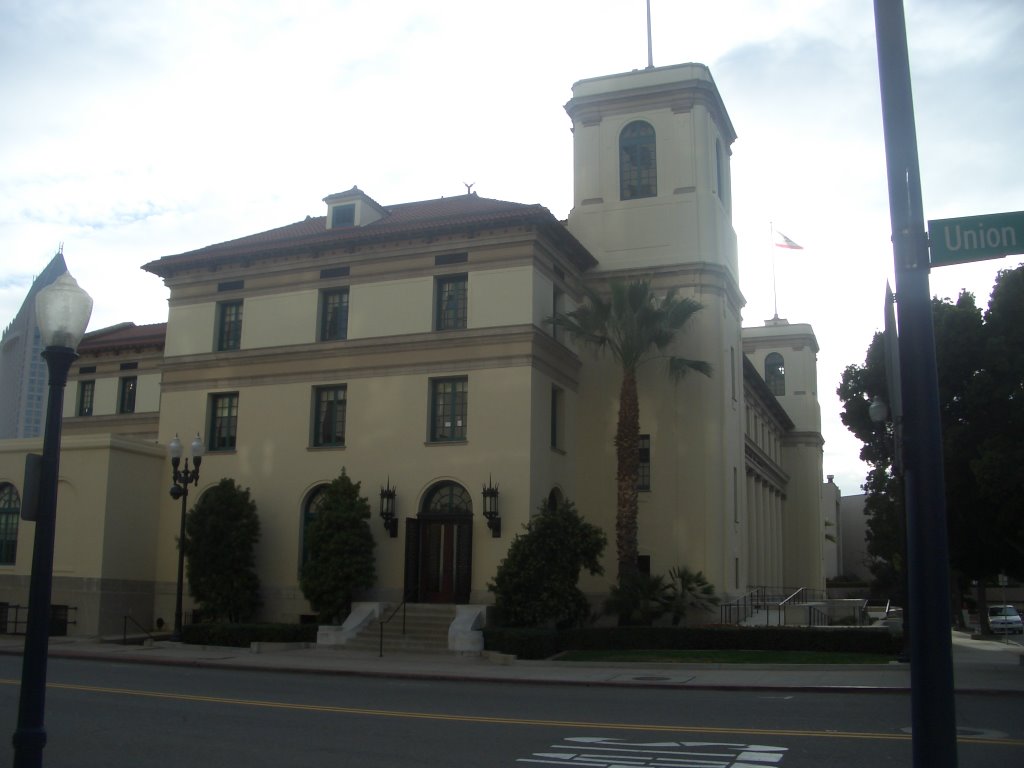
Jacob Weinberger United States Courthouse, San Diego
My wife, Michele, took these photographs of front and side views of the Jacob Weinberger United States Courthouse, during our San Diego vacation last March. You can read about the history of this beautiful building here. Who was Jacob Weinberger? An immigrant from Hungary, who became a Federal District Court Judge and lived to the age of 92. Read more about Judge Weinberger here.